CFD Resistance & Flow Analysis of 102m Ro-Pax Ferry
Technical Specifications
Project Background and Challenges
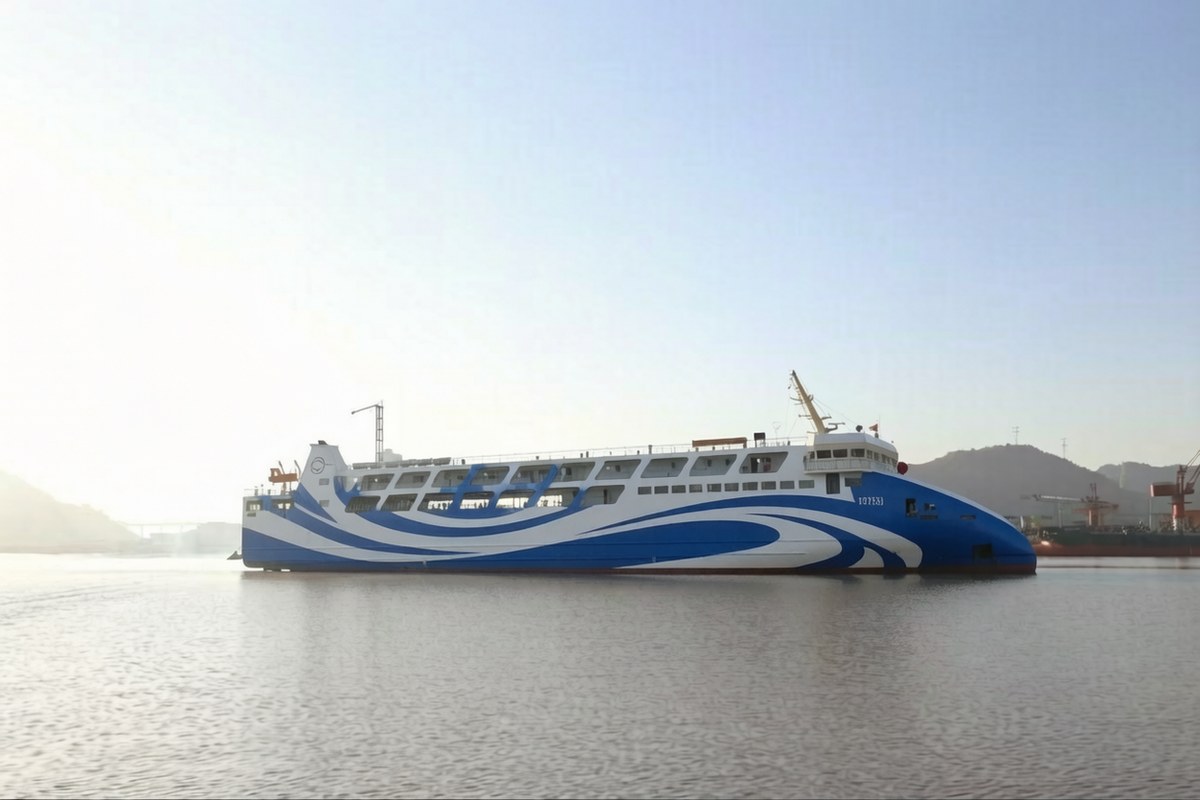
The 102m ro-pax ferry serves inter-island routes in tropical waters, with a shallow design draft of only 4.20 m, a relatively large block coefficient and a twin-screw, twin-rudder aft-engine layout. Shallow draft and high block coefficient make wave-making and viscous resistance sensitive, while non-uniform twin-screw wake can trigger propeller cavitation and stern vibration. At the approval stage, the owner required a rapid baseline of total resistance and hull flow field ahead of model testing, assessment of resistance under the 436 lane-metre / 542-passenger load condition, and quantitative support for bulbous bow and aft-body lines optimization.
Our Solution
A full-scale CFD domain was built from the approval hull form, using RANS with the SST k-ω turbulence model for closure and VOF to capture the free surface and wave pattern. The domain covers bow, stern and wake regions, near-wall y+ is kept below 1, and mesh independence established a scale of about 9.5 million cells. Six speed points from 12 to 18 kn were computed at the 4.20 m design draft, extracting total, pressure and frictional resistance components, analysing the bow wave system, bulbous bow–bow wave interaction, and twin-screw plane wake distribution. Multiple bulbous bow iterations were carried out and the aft body refined to improve inflow uniformity.
Delivery and Results
CFD total-resistance prediction agreed with subsequent model tests within 4%. At the design speed of 16.5 kn, total resistance fell by about 5.5% versus the original lines, with a corresponding reduction in propulsion power. The optimized bulbous bow lowered bow-wave height and improved twin-screw plane wake uniformity, creating margin for cavitation and vibration control. The analysis provided resistance and flow-field evidence for hull-form finalization and RINA submission, shortening the lines-optimization cycle by about 35%.
- Total resistance prediction error < 4%
- ~5.5% reduction in total resistance at design speed
- Improved twin-screw wake uniformity supporting cavitation and vibration control
- Lines-optimization cycle shortened by ~35%